
Writing a novel has always been a fairytale ambition of mine and with never any free time during my days I would daydream of working late into the early mornings, tapping thoughts into my laptop accompanied by a large pinot noir.
So when the PR team of London Book Fair emailed me this week’s programme of events complete with a press release for the ‘How to get published’ masterclass, I jumped at the chance to attend.
Saturday 18th April brought the first hints of a potential summer’s day, and this optimism was reinforced inside the walls of the Earls Court Conference Centre. Chaired by Danuta Kean, an award winning freelance journalist and publishing commentator, who writes for the Daily Mail and Financial Times among various other publications, the 200 plus attendees and I were initially introduced to Simon Trewin; the Co-head of the Books Dept at United Agents, and Bill Swainson; the Senior Comissioning Editor at Bloomsbury Publishing.
Simon’s opening words that “books are the last thing to go into recession and the first thing to come out” seemed apt for a time where everyone is watching the pennies and a dream of a career change is forced not actually chosen, with redundancies inevitable. The majority of those attending had written a fictional or non-fiction piece with the hope to get published, so the speakers were there entirely to be used to aid this dream.
Bill’s first piece of advice was to research the publishing house that would be best suited to your book and find yourself a commissioning editor by sending off your manuscripts. Emphasising the need for patience Bill encouraged sending to more than one agent as often it can take several months to receive any feedback.
“Often smaller independent publishers react quicker and are more effective than bigger well known publishers.
“Publishing is not a machine. It’s between humans. If you get it right it can be extremely rewarding, you just have to have the energy to push on.”
When opened to questions from the floor, the agents were asked of what proportion of the manuscripts were read by the actual agents.
Simon answered that he would read a part from every manuscript, not in entirety – but enough to see if the content grabbed him. Bill added that they aren’t literary judges, they just need to read as efficiently as possible doing justice to the author as well as using time wisely.
When asked how to write a decent synopsis, Bill answered with no hesitation, “when you tell a long story, what are the snippets that you tell your friends in the pub to spark their interest in your topic? Those snippets are your synopsis.” Simon developed this answer by adding “it’s just 8 to 10 lines giving the reader the sense of the territory they are entering.”
A question I was specifically interested in involved libel and defamation laws against your work. Without any doubt the novel I intend to write will be heavily influenced by people and experiences from my life so the following question; “who proves you have used a real life character in your novel?” was extremely interesting. Bill responded with “your concern as a novelist is whether the content works. Let your lawyers and agents/editors worry about that.
“However, your publishing contract states that you cover the publishing house with your words and it will directly affect them if you were to be sued for libel so you do need to take it seriously. Sit down with a lawyer and talk it through and they will work out what can or can’t be used.”
Gareth Sibson, an author and presenter who works across a broad range of social, legal and gender related issues, added, “If the information is true, then you can use that as your defence. It is when it’s not true and it obviously incriminates someone that you need to be worried.”
Danuta then intervened to introduce the multimillion international author of bestsellers Labyrinth and Sepulchre, Kate Mosse, as well as the recently published authors Lola Jaye and Mr Sibson. When asked for one thing they wish they’d known before writing their first novel, they agreed with Bill and Simon’s previous advice, especially their key points to have passion, stamina, patience and put in a lot of hard work.
Kate expanded with “you’re a writer, you have a dream. There is not a moment that you can imagine not doing it.”
Gareth also added the importance of a commercial awareness. Stating that potentially you will make yourself into a brand.
Lola agreed and using her own experiences giggled that “writers are unstoppable and mad. You don’t give yourself a chance to exhale, you are always waiting for that day when you will stop and breathe but it doesn’t come as there is always plenty to write about.
“People constantly reject you but you need to bounce back. Look for the nuggets of gold in their criticisms.
“A major point is to not change your style to suit a genre or niche. Your style is your identity”.
This struck a chord with me as I can never write well when trying to fit into someone else’s area and my style of writing had a pat on the back when Gareth slipped in “I felt like I was seeing a shrink through my laptop, getting my thoughts down – before I knew it this became a book”. This is often how I think my novel may unravel as I often verbally vomit all over Microsoft word when trying to make sense of my emotions and experiences and on return months or even years later am pleasantly surprised by the content, thinking there is a novel in me yet.
With the class drawing to a close the authors hi-lighted the need to push your name and product primarily yourself. Make the commitment and network, whether through blogs, social networking or getting out in person to local bookshops. No-one will publish your work better than yourself.
Lola’s final statement “nothing worth doing is easy” left me smiling from the inside, happy in the knowledge that I had put myself on the perfect career path and am in total control of my novel-writing future.
The London Book Fair is taking place from the 20th – 22nd April 2009 at Earls Court, London.
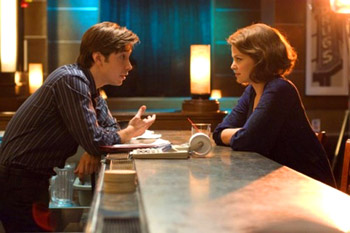
 Does this mean that men will never love us in the way we hope for unless we are the ‘exception’, or is it that we are too selfish to see that they may not want the same things as us even if they still love us? This is where I introduce the married couple Janine, Jennifer Connelly and her husband Ben, Bradley Cooper. While Janine demonstrates security through boasts to her work colleagues of a true soul mate in her husband, a chance encounter between Ben and a young musician, Scarlett Johansson, jeopardises this security for us as an audience when we see lust take control of Ben and a steamy affair occur. This only led me to wonder, even in the happiest of relationships, how can we prevent destructive occasions from arising? The answer can only lie in hope and trust. This trust is the previously mentioned pain in my gut, as this is something we could never control.
 Whose Boots Are Those Shoes?